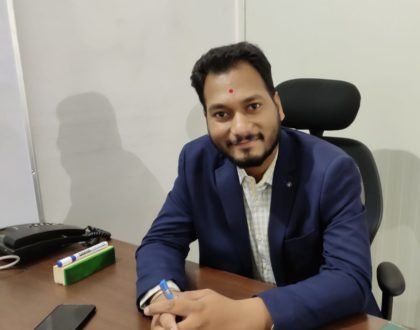
Rohit Shinde, design head at Indus Robotics talks to us about his journey from an engineering student to starting his own company, what his job entails and the kind of machines he produces.
Tell us about your journey?
I belong to a middle-class family and in the beginning, it was quite difficult to envision having my own company. I was an engineering student who was interested in new technologies like robotics arm. During my graduation, I participated in several competitions organised by SMA, NASA and IIT-Kharagpur. At one such competition at IIT-Kharagpur, I won the third prize and the panel of judges was quite impressed with my design.
When I was a child, I had read somewhere that if you want to get into the field of designing a robotic arm, you need to either study electrical engineering or mechanical engineering. As fate would have it, I pursued mechanical engineering. After my graduation, I was selected for the position of a design engineer at Indorama, one of the biggest companies in Nagpur. During my tenure there, as I was in the maintenance team, my sole task was to check which machine had a problem and required fixing. For example, my colleagues would tell me that machine number 10 has this problem, machine number one has that problem etc. My job was to allot a team who knew that particular machine and fix it. Though the pay was good, the job wasn’t challenging enough so I left the company and joined Bajaj Steel. In 2011, I realised that I wasn’t doing the things I had dreamt about so I left Bajaj Steel.
One night, after talking to my friend who is also my partner now, we decided to build our own company where we would manufacture robotic arms.The three musketeers- Harshad Wasule, Hrishikesh Gokule and me started our company in 2013 in Nagpur.
Each and every step was new to us. We didn’t know the intricacies of running a company. But we were passionate and we persisted.
In India, a lot of companies like Kawasaki and Panasonic charge huge amounts of money to make a robotic arm. We wanted to cut down the cost and sell it at a reasonable price. We selected a CNC machine and worked day and night, learning all the softwares and systems, to make it a success.
We shifted to Pune as equipments, skilled labour and customers were easily accessible here. We received immense support from the local vendors and customers and as each day passed, we became better at running the company and making the machines. It’s been five years now and we have 70 machines running across India. In 2020, we are even planning to export our machines abroad.
Our clientele includes Midas Tool in Pune and BPL in Bengaluru. We have done a lot of business in Gujarat and Delhi as well and have even opened a new service branch. We have sold a robotic arm in Mumbai and are now developing new products like HD line automation. So, all in all, our journey has been very fruitful. We have a great team and the best customers who have always had our back, no matter what.
Can you tell us about your first pay check after you started your own company?
There are innumerable CNC machines in the market but we selected PCB CNC machine. During my college days, we used to make PCB’s printed circuit boards that you might have seen on mobile phones. I knew someone in Nagpur who had a small firm that made PCBs. When we were creating a CNC machine, we met him for a brief chat where he asked us, ‘why don’t you make a PCB drilling CNC machine?’
They were also entrepreneurs like us and were facing a lot of challenges. Since operators were not easily available, they were unable to achieve their target value.That’s the reason they wanted us to create a CNC machine for them.
As I recall, there is a funny story there. At our first demo showcasing our CNC machine, we had quite a few glitches since we lacked experience. We had made a spindle and the motor we used was that of a mixer. In my defence, we had even tried using a washing machine motor. I think since we created all the components from scratch except for the motor, the end product was not that good. But at the next demo, we sold the machine. If you compare the two machine- the machine at the first demo and the machine we sold, you will see a huge difference.
We never wanted our machines to have any problems or fail. That’s why we invested heavily in R&D softwares and programming. After one and half years since we started our company, we got our first pay check.
Robotics as a field is a wide area. So what is your focus and area of expertise, at present?
We made robotic arms for two purposes- palletising and decathalising. Right now, we are working on these and in the upcoming year, we will launch a robotic arm.
How are you managing the softwares and the motors?
Since we are three partners, we have distributed work depending on the individual’s expertise. I look after the mechanical design, Harshad looks after the softwares and Hrishikesh takes care of sales and marketing and the legal department.
Tell us about the new products you are developing in detail?
We are focusing on HD automations right now. There are several products in HD automations like egg washing machine, egg fumigation machine, egg grader (a machine that differentiates the egg by weight), egg transfer machine, egg setting machine and an egg incubator. An egg incubator is used on big farms. For example, if the capacity is 1.5 lacs eggs per day for hatching, it is not possible to have 1.5 lacs hens. That’s when this machine comes into play. All you have to do is put the eggs in the machine and the machine controls everything, from temperature to light, carbon dioxide and other chemicals. It is a 21 day process and after 21 days, you will have small chicks hatching from the eggs. We will be launching these products at the upcoming exhibition scheduled in November.
That’s quite interesting. But since agriculture is not doing so well in India, do you think your customers will be able to afford these machines?
This field is quite different from agriculture and doesn’t have much to do with agriculture. Big players like Venky’s and KFC, who deal with chicken and eggs, are in this field. So, they will be our customers.
It’s great to hear that your Make In India project is successful.
It is our passion and the need of the hour. The big robotic arm companies, who are also in the HD line, are charging heavily. That is why we selected HD line so we can provide robotic arms and incubators to several small scale and large scale industries who can’t afford the expensive equipment manufactured by these big companies.
My ideology is if God has blessed us with something, why not use it for the development of our country and its people.
What are the various challenges you are facing?
In the beginning, funding was a major challenge. There are a lot of challenges we face even now but we are able to manage them.