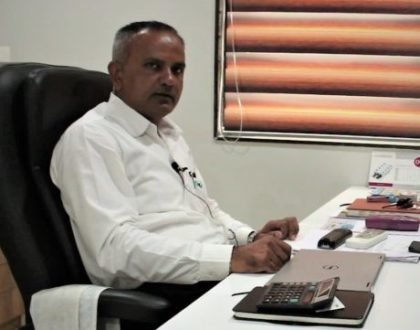
In this edition, we meet up with Mr SP Singh, CEO of Rimaco Industries, Ghaziabad. Rimaco Industries is known for its double disc grinding machines.
Below is an informal tête-à-tête with Mr SP Singh.
- For the benefit of our readers, please tell us about your company. How did you enter this industry?
Mr. S.P. Singh: Initially we started the company under the name of Ring Manufacturing Company but later as machines became our major business we converted the name from Ring Manufacturing Company to Rimaco industries
As far as the story regarding development of double disc grinding machines is concerned, when I was working with Shriram Pistons in 1986, the company bought a machine from “Diskus Werke” Germany. At that time a 600mm wheel diameter machine was costing Rs.70 lakhs. It was a huge amount in the 80s and, looking into the cost and the machine, I figured it was too high.
We tried to develop this machine in India with HMT and provided them whatever data was required. Then they designed their own machine with horizontal spindle and supplied one machine to Shriram Pistons also. I understand HMT is now supplying this machine all over India and abroad as well.
Since the imported machine was very large and beyond the financial reach of small customers, I decided to quit and start on my own with whatever technical input that was available with us. We developed the machine indigenously.
I designed a small machine with 400mm grinding wheel diameter and supplied it to many clients. Once the results were successful we approached other manufacturers of piston rings and bearings circuits and gradually our machines were approved by various manufacturers. Slowly yet steadily we were recognized all over the country. By participating in Intex and other exhibitions our visibility improved as well. Till now we must have sold more than 250 machines all over India.
We have sold three machines in Thailand and are working very well after commissioning. We are currently manufacturing a machine in 750mm wheel diameter for a customer in the USA, expected to be shipped in August.
Q: This is great news. Well, the success story of the double disc grinding machine must be indeed gratifying to you. But tell us, what made you to come out of the corporate world and become an entrepreneur?
I think it was nothing but the demand in the country and the skills I possessed. Maybe the latter is god gifted. I always had this keen interest and curiosity in understanding the technology of spindles and what makes it to run so perfectly! Whether the quality is in the spindle or it is in fixture. So that was something of immense interest to me. Whenever I visited a company or when i stood in front of a machine. I thought if I enter the world of manufacturing machines, maybe I’ll be able to serve the industry better, than by doing so in a production job.
And I started a small unit and gradually now I’m working with more than 60 – 65 people only in building double disc grinding machine and special purpose machines.
Q: What is the speciality of your company? Is it import substitution? Are there other manufacturers of such machines in India?
Yes! It is definitely an import substitute for small manufacturers. Bigger manufacturers can afford to buy from Japan, Korea, and Italy. Smaller manufacturers cannot afford the price of imported machines.
You should understand that the cost of production of components is very high. When big players launch a new project the first machine they buy from HMT or from a foreign manufacturer. But later I supply my machines when they expand their capacity. And they are satisfied because our components are equally good.
Q: What are the challenges you are facing at this moment in the industry?
Actually the requirement is huge and our resources are very limited. We have to make some investment in research and development; we have to have 4 – 5 machines together where we can keep developing different products. These 4 – 5 machines require at least 3 to 4 crore rupees! Moreover, we need very skilled people who can work on those machines day and night. Then only can we develop products based on the requirement of big industries, such as brake discs.
Or, for example, products like bigger bearings of 400 and 500 diameters. These are special double disc grinding machines, and these products are not something you can simply sell. You cannot take the order and manufacture the machine and then supply it. You need to have the technology in house, prove the quality of the component and then negotiate with the customer.
So for that purpose, I’m planning on those lines and aim to establish a small R&D centre in our company. This way I can help the industry in a better way.
Q: Have you tried to take support of the DSIR of the government for this R&D centre?
No, not yet.
Q: Has GST helped you in your business?
Yes! GST has simplified business in a big way. We have no problems now in transferring material from one company to another. You charge GST when you sell, further transfer to another company, and the GST is adjusted there. So there’s no problem at all.
Q: Has GST helped in reducing paper work? Earlier there was Form C, now you don’t require anything of that sort?
Actually my staff is still busy issuing the C Form for previous years, but I believe once all backlog taxation matters are over, it will ease the workload of my accounts section too.
Q: Are you exhibiting in Imtex exhibition in 2019?
Most likely we will be participating.
Q: Any new plans in your mind?
Yes! As I told you we are planning to set up a small R&D centre, where we intend to develop different kinds of machines for grinding bigger components. We are planning to develop a fine grinding machine also, which is a next operation to grinding. Its a replacement to lapping. A grinding machine with seaming wheels.
Q: Is it available in India or are your making it for the first time?
Companies like Lapmaster are already manufacturing and Peter Walters in Germany are already supplying these machines, but at a very high cost. I want to manufacture a machine which is affordable by common manufacturers. That is our target. Machines are already there but only foreign players are there in this field. No indigenous quality manufacturer.
Q: Who are the typical customers for your machines? Which industry requires your machines?
Most of them are related to automobiles, whether it’s bearings, circlips, wall plates, and piston rings, they are all requirements of the automobile industry.
Q: And how is the industry doing these days?
Fantastic! We have good orders.
Q: What is your expectation from the policy makers? Do you seek any specific policy intervention from them?
I think the ease of doing business should be focussed, for instance, funding is a major concern, then labour is another area. You have to keep 50% people on roll and 50% without, we have to adjust with this because skilled manpower is not available, people come and go so the labour turnover is very high. I feel there should be some kind of relaxation for small industries so we can recruit people once they are trained, we can take them on roll keep them under ESI and PF.
We don’t mind paying them ESI & PF but right from day one it is very difficult for small industry like ours.
It means a lot of people working and after a week he will leave, so whatever we have paid or invested in his training goes waste.
Q: Finally, any message for our readers?
I think our country is moving ahead in a big way and we all should work hard and make our nation a first ranker. That is my submission to your question.